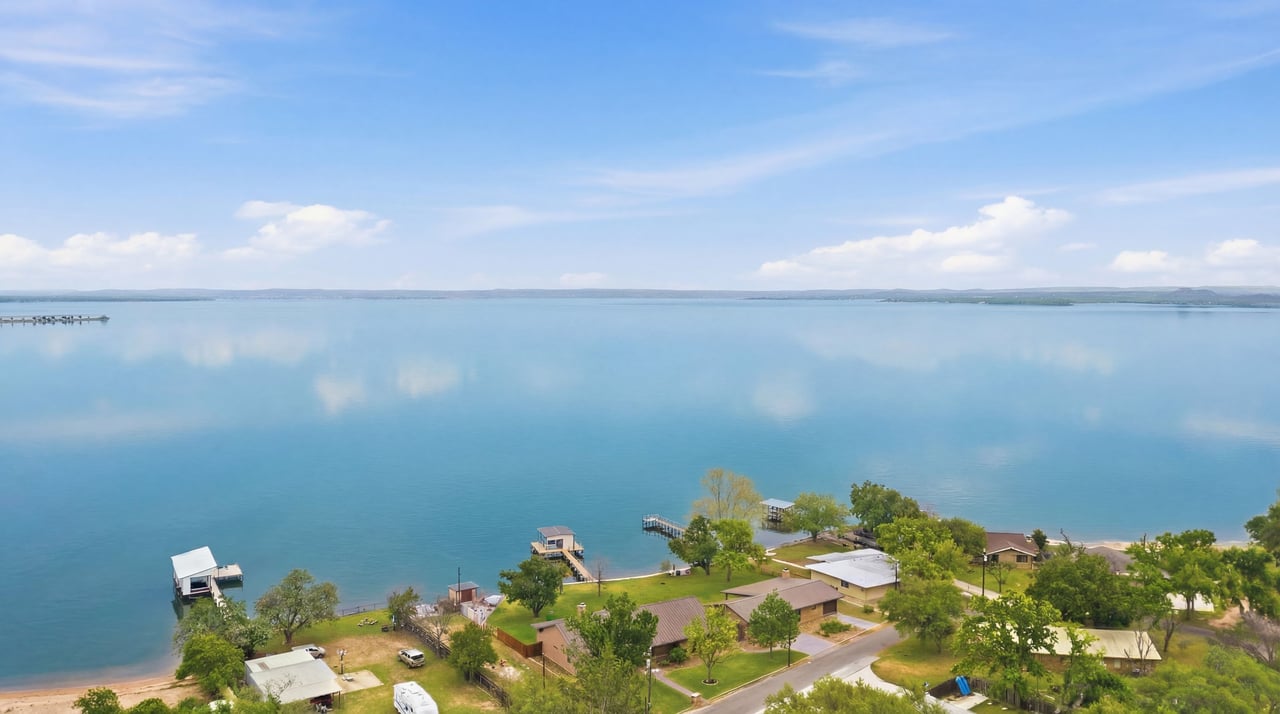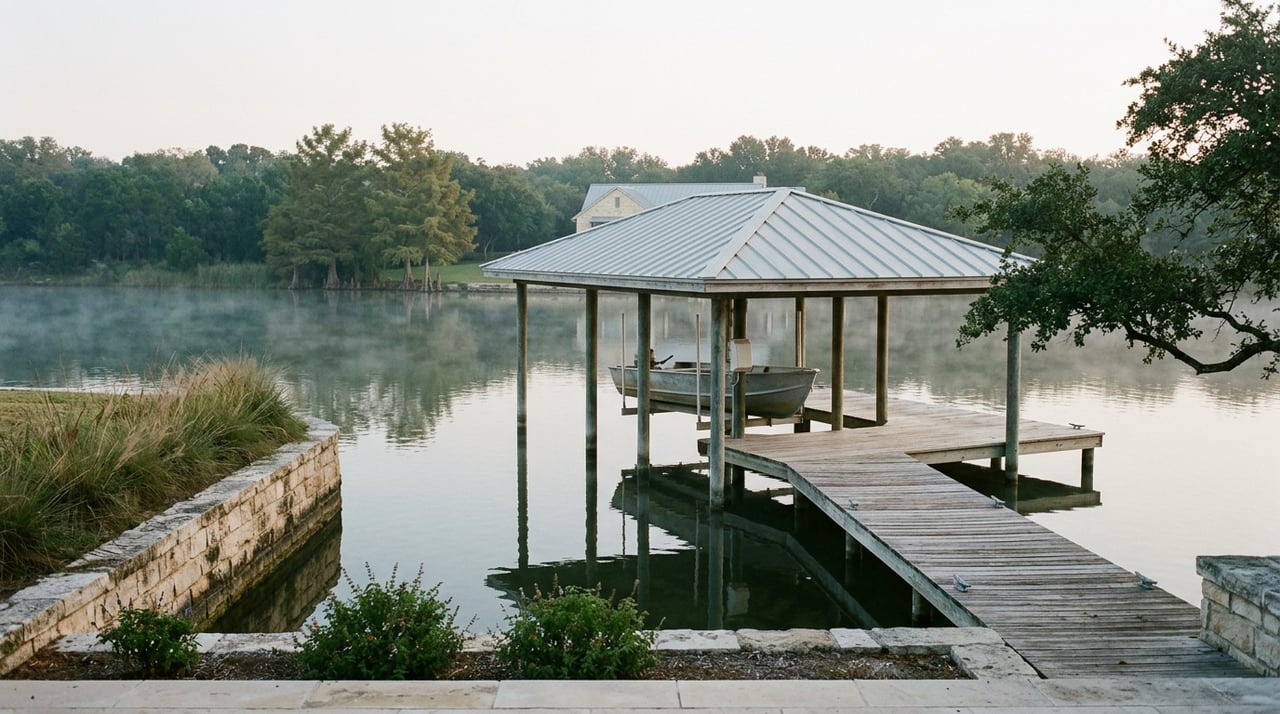
Every agent working the Highland Lakes will tell a buyer the same thing about Lake LBJ within the first five minutes: it's a constant-level lake. Say it like that and it sounds like a solved problem, the one variable that Lake Buchanan and Lake Travis buyers still have to sweat. And it's true, as far as it goes. But treat "constant level" as the whole story and you'll miss the two things that actually decide whether a Lake LBJ property works the way you want it to: whether the marina near you has room for your boat, and whether your dock sits on open water or on one of the river arms that took the worst of last year's flood debris.
Water level was never the risk that mattered most here. Slip access and arm location are.
What "Constant Level" Actually Buys You
Lake LBJ, along with Inks Lake and Lake Marble Falls, is managed by the Lower Colorado River Authority as a pass-through lake, which means it's held to a tight operating band rather than allowed to rise and fall with rainfall the way a storage reservoir does. In February 2026, marina reports on the lake put it at roughly 824.8 feet above mean sea level. Heading into this fall, that same lake was being described as holding steady around 824.5 feet. That's a three-tenths-of-a-foot spread across most of the year, on a lake where boat lifts, fixed docks and shoreline landscaping are all built assuming the water stays put.
Compare that to Lake Buchanan over the same stretch. As of mid-February 2026, Buchanan sat at 94 percent capacity, nearly seven feet above its historical average for the month, a swing driven entirely by upstream rainfall and reservoir storage decisions. That's the difference constant-level management is actually solving: not whether you'll have water, but whether your dock height, your landscaping and your boat ramp will still make sense next season. On LBJ, they will. That part of the sales pitch holds up.
Where it stops holding up is everything downstream of the water itself.
The Rule That Actually Rations the Lake
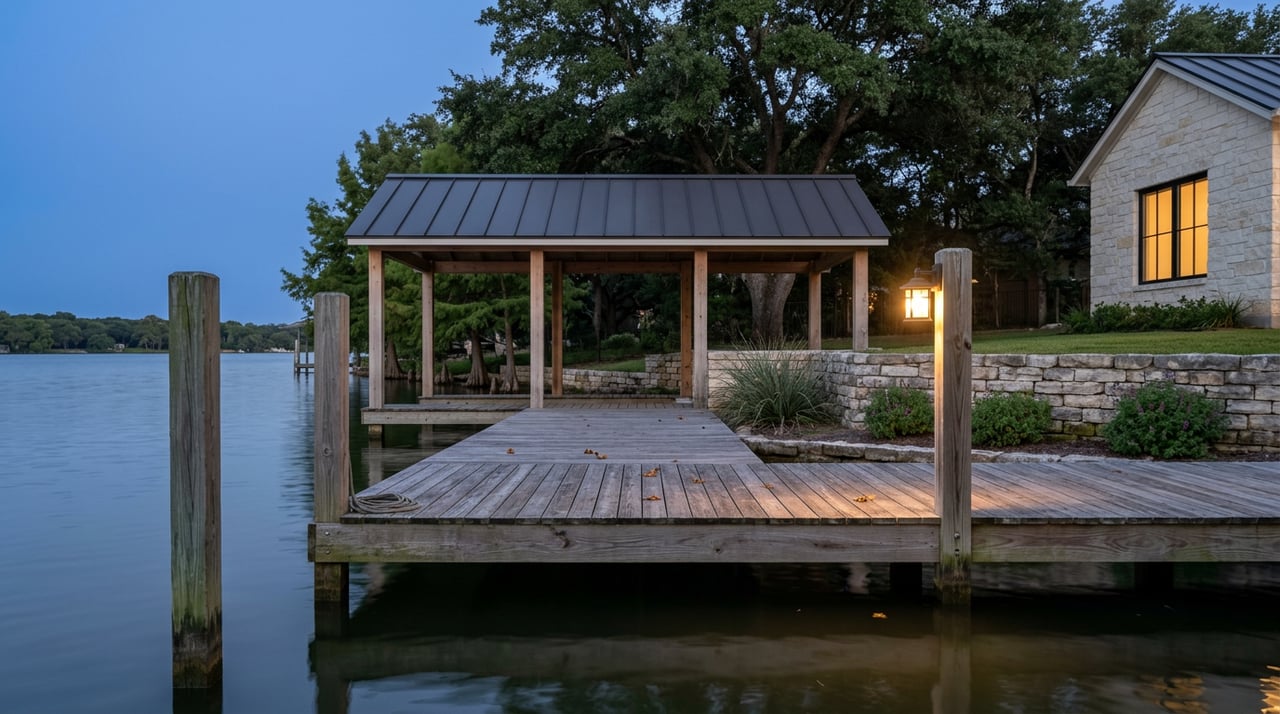
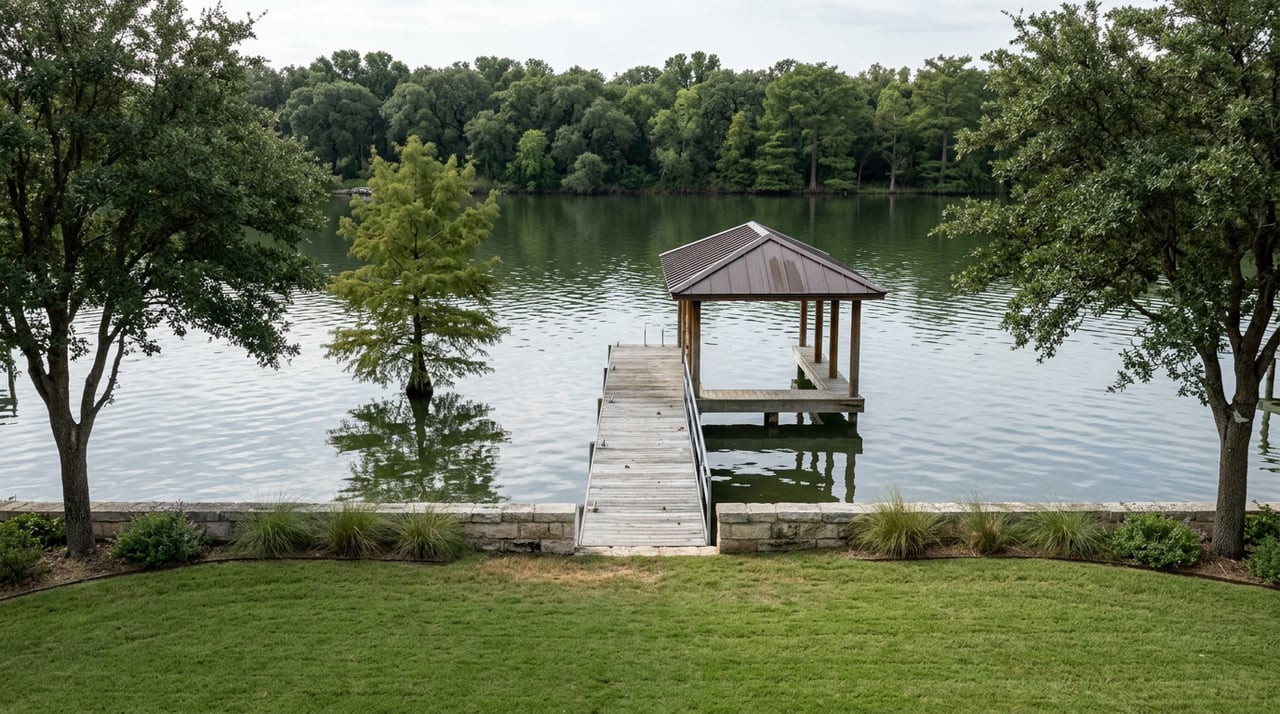
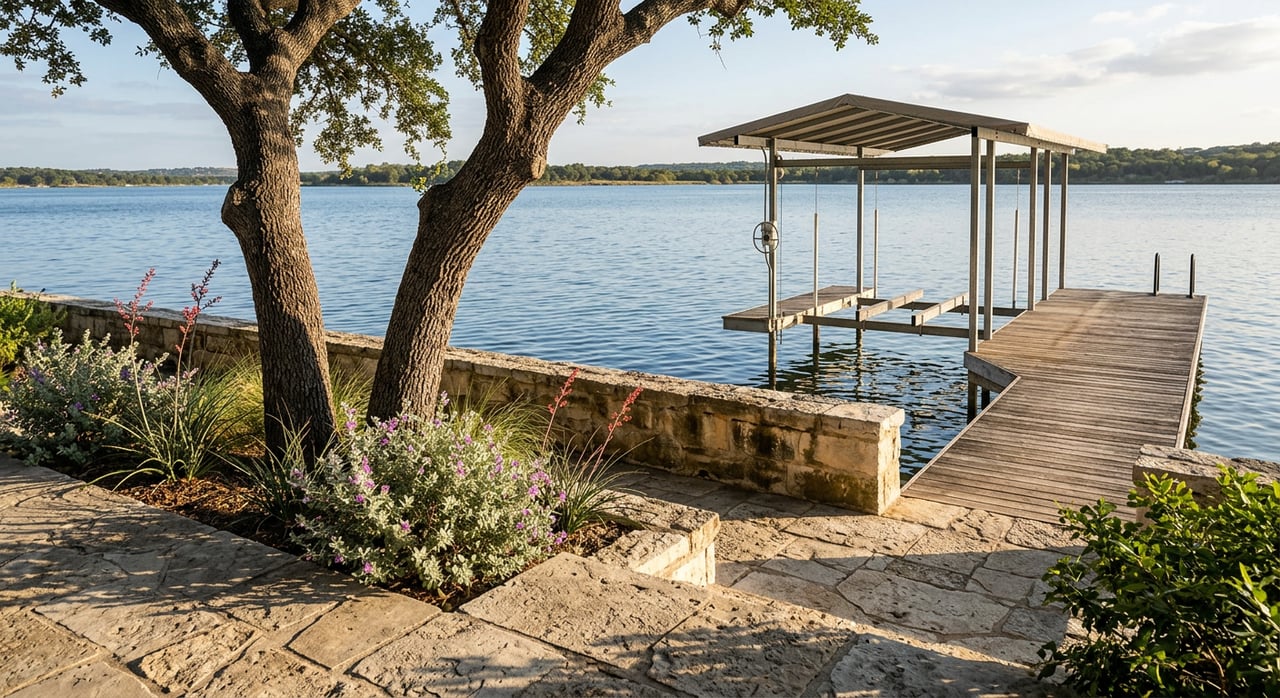
If you want to build a private residential dock on Lake LBJ and it comes in under 1,500 square feet, the LCRA doesn't require a permit, a registration, or a fee. You still have to meet the agency's safety standards for flotation, lighting, anchoring and distance from shore, but the process is largely between you and your builder.
Marinas are a different animal entirely. Any marina on Lake LBJ, or on Buchanan, Inks, Marble Falls or Travis, has to be built and operated under an LCRA permit and has to comply with the Highland Lakes Marina Ordinance. That ordinance got a significant rewrite on May 24, 2023, and two of the changes are the reason marina slip access on LBJ has quietly become the tighter constraint than the shoreline itself. The update phased in higher marina fees over two years, gave marinas a two-year window (now long since closed) to replace unencapsulated foam flotation, and banned new community marinas outright, meaning no new facility can be built to serve a neighborhood or subdivision in place of individual residential docks.
Read that plainly: the supply of new marina capacity on Lake LBJ was frozen by regulation, not by geography. Existing marinas can expand within their footprint if the LCRA approves it, but nobody is building a new one to serve the next subdivision that goes in near Kingsland or Horseshoe Bay. If you're buying a home without deeded waterfront and counting on marina storage nearby, you're competing for a fixed pool of slips in a market where the buyer pool keeps growing.
What Slip Expansion Actually Looks Like in 2026
The LCRA's own permit tracker shows exactly one active example of marina growth on Lake LBJ this year, outlining the steps involved in an expansion. An existing marina applied to add 23 wet mooring slips and three courtesy slips, along with replacing its ship store, boat launch ramp and marine service station. The public comment period on that application closed April 24, 2026. The LCRA issued the permit June 3, roughly six weeks after the public comment period closed.
Twenty-six new slips, after a multi-month regulatory process, is the entire visible growth in marina capacity on Lake LBJ this year. If you're weighing a property based partly on "there's a marina nearby," ask whether that marina's slip waitlist is open, whether an existing lease transfers with a sale, and how long the current waitlist actually runs. Those questions tell you more about day-to-day usability than the listing photos do.
| Highland Lakes type | Examples | What LCRA manages toward | What buyers should watch |
|---|---|---|---|
| Storage lakes | Buchanan, Travis | Water supply, absorbs rainfall swings | Seasonal elevation, dock adaptability to changing shoreline |
| Pass-through / constant-level | Lake LBJ, Inks Lake, Lake Marble Falls | Stable daily recreation pool | Marina slip access, permit status, arm vs. open-water location |
The River Arms Are a Different Lake After July 2025
Here's the part that a simple "constant level" pitch skips entirely. The July 2025 floods that hit the Highland Lakes region didn't just raise water temporarily. They introduced a meaningful amount of submerged debris into the system, and as of February 2026, boaters and marina operators were still reporting hazards specifically in the northern end of Lake Buchanan and in the river arms of Lake LBJ, the kind of narrower inlets where creeks like the Llano River arm and Cowhouse Creek feed into the main lake.
That distinction matters because a stable pool elevation says nothing about what's sitting on the lake bed. A property on open water near the main body of LBJ and a property tucked into a river arm can both sit at the same 824-foot pool level and still carry very different risk profiles for a boat prop, a dock piling, or a swimmer. Submerged debris doesn't wash away just because the water level holds steady. Someone has to find it and clear it, and that work happens unevenly and slowly across a lake this large.
If a property you're considering sits on one of LBJ's river arms, ask directly whether the specific stretch of water has been checked or cleared since the 2025 flood, and don't assume that "constant level lake" answers that question. It doesn't.
Questions Worth Asking Before You Tour a Dock
A few due-diligence questions turn this from an abstract regulatory story into something you can actually use on a property visit:
- Is the existing dock under 1,500 square feet and therefore exempt from LCRA permitting, or does it require documentation you should ask the seller to produce?
- If the property relies on a nearby marina rather than a private dock, is there an open slip, and does any existing lease or membership transfer to a new owner?
- Has the marina serving this property completed its unencapsulated foam replacement, given that the two-year compliance window created by the 2023 ordinance update has already closed?
- Does the lot sit on open water or on a river arm, and if it's an arm, has that stretch been checked for flood debris since July 2025?
- What has the lake's actual elevation looked like over the past twelve months, not just today, since even constant-level lakes operate within a band rather than a single fixed number?
That last one is easy to check yourself through the LCRA's public Hydromet lake level reports, which track real-time elevation across the entire Highland Lakes chain. It's worth five minutes before any tour.
A Few Questions Before You Sign
Does "constant level" mean my dock never needs adjustment? No. It means the swings are measured in inches rather than feet across most of the year, which is a real advantage over a storage lake, but the LCRA's own guidance still describes drought and flood responses that can push levels outside the normal band.
Can I build a private dock without any LCRA involvement at all? If it's a residential dock under 1,500 square feet, you don't need an LCRA permit, though you're still required to meet the agency's dock safety standards. Anything larger, or any marina, needs a permit under the Highland Lakes Marina Ordinance.
Are any new marinas being built on Lake LBJ right now? Not new community marinas. The 2023 ordinance update banned those specifically. Existing marinas can still apply to expand, as the Marine Land project on LBJ did in 2026, but that's expansion of existing capacity, not new facilities.
Is a river-arm property automatically a worse buy? Not automatically, but it deserves a more specific set of questions than an open-water lot, particularly around debris clearing since the July 2025 floods and dock access at different points in the lake's operating band.
The properties on Lake LBJ that hold their value best over the next few years won't be the ones that simply advertise a stable water level. They'll be the ones where the dock situation, the marina access and the exact stretch of shoreline have already been sorted out before the sign goes up. That's the kind of detail that doesn't show up in a listing photo, and it's exactly the kind of question our team at LandMasters Real Estate walks through with buyers before they ever make an offer on the water. If you already own on Lake LBJ and want to know what your dock, your slip access, and your specific stretch of shoreline are actually worth in today's market, request your Instant Home Valuation and we'll help you sort fact from marketing before you decide what's next.
This article is general information, not legal, tax or financial advice. Consult a qualified professional about your situation.